Radically inclusive, Heart-centered, Interspiritual, Meditative, Engaged Spirituality!

Search This Blog

Showing posts with label Jesus. Show all posts

Sunday, July 12, 2026

Series Introduction: Is New Age Occult?


Books pictured: Reiki for Beginners by Victor Archuleta, Linda Goodman's Star Signs, Meditations on the Tarot, A Journey into Christian Hermeticism by Anonymous, The Golden Bough by James Frazer, and The Tibetan Book of the Dead, with commentary by C.G. Jung;  also a set of Mythic Tarot Cards, a set of Chi balls, a sheathed dagger, and a sitting Buddha candle holder with candle

This is the first part of an 8-part series.

The question “Is New Age occult?” came up recently in a group discussion. It sounds like a relatively simple question, but the more I considered it, the more I realized that almost every word in the question requires examination.

For instance, what do we mean by New Age? What do we mean by occult? Are we using “occult” in its older sense of hidden or esoteric knowledge, or as a synonym for something forbidden, dangerous, or even…evil? Finally, by what standards are we making that judgment?

My own perspective on these questions has been shaped by a spiritual journey that crosses several traditions. My foundational Christian formation was Methodist, arising from the broader Anglican tradition. That foundation continues to influence me, particularly its concern with grace, transformation, lived faith, and the fruits of spiritual life.

Over time, my perspective has become broadly progressive, drawing upon scripture, tradition, reason, and experience as resources for discernment. I remain engaged with the teachings of Jesus and also acknowledge a genuine place for mysticism and direct experience of the sacred.

I majored in Religious Studies with a minor in Anthropology before earning my Master of Divinity. My spiritual studies have also included Theosophy, Celtic and Norse Neo-Paganism, Wicca, and Druidic traditions, as well as some study in Eastern traditions.

I understand the Divine in broadly panentheistic terms: all things exist within “God,” and “God” is present in and through creation yet remains infinitely more than creation. I find ritual meaningful, earth-centered spirituality important, and Goddess spirituality useful and empowering as part of an expanded language and imagination for the Divine. I might equally refer to “God,” “Goddess,” or “Gods,” meaning that which is in and around All That Is. In some ways, I see “God” in the idea of quantum physics. I see spirituality as a process rather than a finite thing.

Because of this background, I do not approach the word occult as synonymous with evil. I understand it first in its older sense: that which is hidden, concealed, esoteric, or concerned with dimensions of reality not immediately available to ordinary perception.

At the same time, I do not believe that spiritual knowledge, or gnosis, ultimately belongs to a chosen few. Preparation, study, initiation, tradition, and community all have value, but no institution, priesthood, lineage, or esoteric circle owns access to the Divine.

This leads to an important distinction that will run throughout this series: Mystery is not the same thing as secrecy. Something may be available to everyone and still remain inexhaustibly mysterious.

This series is not an attempt to declare everything called New Age spiritually good, nor is it an attempt to dismiss Christian concerns about spiritual discernment. It is an invitation to examine the categories themselves.

Over the course of these articles, I will explore the older meaning of “occult,” Christianity's own relationship with mystery and the unseen, my own framework for discernment, panentheism, ritual, Goddess spirituality, gnosis, and the question of who, if anyone, gets to claim ownership of spiritual truth.

Ultimately, I am less interested in deciding which label makes a spirituality safe or dangerous than in asking what its fruits are.

Does it deepen love, compassion, justice, humility, freedom, and connection? Does it awaken us to the sacredness of one another and the Earth? Does it encourage discernment or demand unquestioning certainty? Does it empower, or does it create dependency? Does it open us more deeply to mystery, or claim to possess it?

Perhaps the question “Is New Age occult?” is not a question that needs a simple yes or no. Let’s look at it as a doorway into a much larger conversation. This series is my attempt to enter that conversation.
 

Monday, December 25, 2023

The Crack Where the Light Gets In

Or, Christmas on the Event Horizon

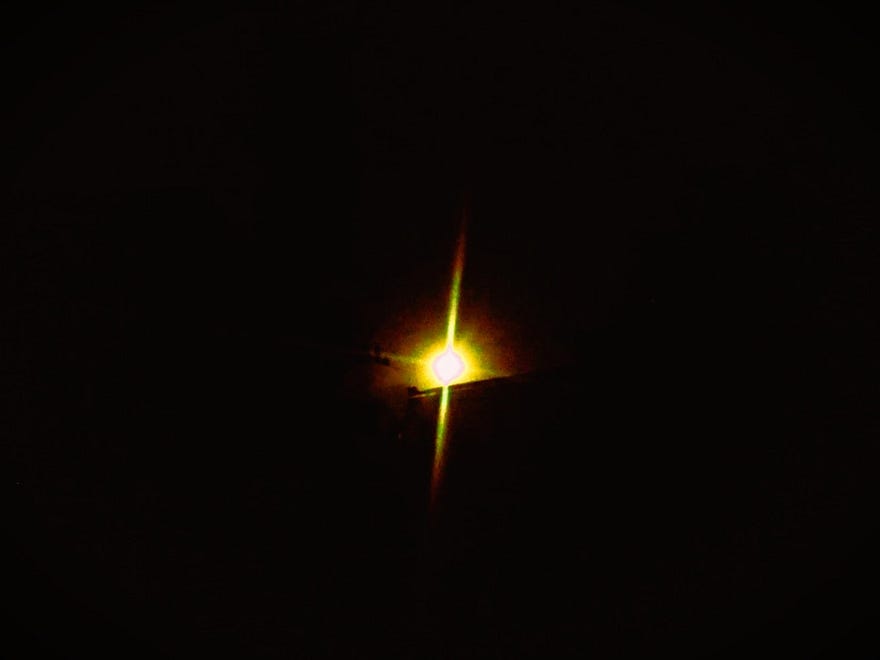
Photo by the author

Disclaimer: As I refer to quantum physics in the following story, I make no claim to have a strong understanding of the concepts. I simply share my perspective based on my somewhat intuitive interpretation of what I have read about it.

A number of years back, I was reading the Diane Duane Young Wizards series. I came to the series on the recommendation of my son, and I truly enjoyed the story. In this series, the wizards’ work is to slow down the entropy that was introduced into the world when one of the Powers of the Universe went rogue, becoming the Lone Power, or the Lone One.

It isn’t hard to draw parallels between this plotline and Judeo-Christian tales of fallen angels and the beginning of death in the world. However, the theology of Duane’s young adult series is not that of traditional religious teachings; rather, it’s more mystical…and more scientific.

Ms. Duane has an educational background in astronomy and astrophysics, and may not have been thinking about theology…but I was. What I was reading about in her books was Process Theology. Duane was writing about life and death. She was writing about teamwork and she was writing about hope.

That’s what it’s all about, you know; hope and our part in maintaining hope in our world.

Death is not the end of things. Isn’t that one of the real messages of religion, that there is nothing to fear from death? Doesn’t religion teach that we are to work together, to give one another hope when the darkness seems inevitable?

The young wizards in the series each have their own Ordeals to undergo, and their own tasks to perform, yet they work with one another to keep the Lone One at bay. In the third book of the series, High Wizardry, Ms. Duane writes of the Lone One, “…It doesn’t have infinite power. It’s peer to all the Powers, but not to That in Which They Move.”

According to Luke, in Acts 17, Paul taught that we “live and move and have our being” in God. Jesus claimed that he was The Light of the World, yet in his Sermon on the Mount, he is recorded as teaching that we are the Light of the World.

How can that be? How can both be true?

Process Theology uses the language of quantum physics to explain the invisible intelligence behind — and in — all creation.

“Wave and particle,” writes theologian Marjorie Suchocki in Divinity and Diversity: A Christian Affirmation of Religious Pluralism, “are both truly light, and we live in a radically incarnational world where truth itself is a many-splendored thing.”

Like the quantum elements of light, God is like a wave that is constantly moving and flowing, until such time as a thinking being perceives the Presence of God. At that point, God is like a particle, and that particle is named according to the cultural expectation of the one who perceives that Presence.

In scientific arenas, that “perceiver” is called the “observer.” For the Christian observer, that “particle” is named Jesus.

I believe that Jesus is a “manifestation of God with us;” as Suchocki writes in God-Christ-Church: A Practical Guide to Process Theology. To continue with the analogy of quantum physics, Jesus is an observable particle of the wave that is God. He is a particle of the Light that when observed reflects the qualities of the ineffable, invisible wave of “All That Is.”

I might call the birth and death of Jesus “event horizons.” In quantum physics, the event horizon is the boundary of a black hole. To enter into a black hole would mean certain death. In his popular book A Brief History of Time: From the Big Bang to Black Holes, physicist Stephen Hawking describes a black hole as a “boundary of the region of space-time from which it is not possible to escape.”

Yet, he describes a singularity as “a point in space-time at which the space-time curvature becomes infinite.” The birth and subsequent resurrection, then, are the “singularities,” for once born, Jesus is an identifiable individual in history; once resurrected, Christ is infinite.

The hope we find in this story is this: as Jesus was the Light of the World, so also are we. We are, each and every one of us, manifestations of “All That Is,” or as Diane Duane writes, “That In Which [We] Move.”

Born of the wave into this material world, we are truly the Light of the World. When we see that, when we connect with the Christ, who is with us in the Holy Spirit, we know the Light as Love, and we begin to reflect it. This is our job. We are the wizards of this world, trusted to slow down the darkness of death and shine the light on eternal love.

We are not perfect reflections of God’s love; indeed, we are flawed and we sometimes fear the things we do not understand. We don’t understand death, this threshold between this world and the next. We don’t understand other people, these also flawed beings whose light may not shine as brightly as another’s or who may seem not to shine any light at all. We need not be perfect.

We need to keep letting our light shine so that it might get into the cracks and ignite their glorious flame. As poet Leonard Cohen wrote, “There is a crack in everything, that’s how the light gets in.”

This Christmas, as we light our candles, say our prayers, and sing our hymns, let us risk allowing our cracks to show, that we might find ourselves poised on the edge of the event horizon, welcoming the Christ into the world.

Let us remember that we are all brilliant particles of the Light of God, and we shine the brightest when we shine together.


(c) Suzy Jacobson Cherry

Is New Age Occult? Mystery, Gnosis, and Spiritual Discernment, Part Eight: What kind of person does a practitioner become?

This is the last part of an 8-part series. You can start with the Introduction here . We began this series with a seemingly simple question:...