Radically inclusive, Heart-centered, Interspiritual, Meditative, Engaged Spirituality!

Search This Blog

Showing posts with label Process Theology. Show all posts

Saturday, September 13, 2025

Druidess: My Interspiritual Priestess Path Leads Me To Druidry


I am an Interspiritual priestess, which means I honor wisdom wherever it flows, whether it be through Jesus’ teachings of compassion, John Wesley’s vision of prevenient grace, the Avalonian mysteries reclaimed by Jhenah Telyndru and the Sisters of Avalon, the mythic landscapes illuminated by CaitlĂ­n and John Matthews, or the prophetic spiritual imagination of Matthew Fox. Each voice, these and many others, contributes to the tapestry of my life, helping me navigate a sacred path that is both grounded and expansive.

What I see at the heart of Druidry is also at the heart of my priestesshood. It is Awen, the flowing spirit of inspiration. In Druidic tradition, Awen is the creative current that animates the universe, carrying poetry, ritual, and sacred knowing. It is the same Spirit that Evelyn Underhill explored in her writings on contemplative prayer. It is a presence that invites the soul into direct experience of the Divine. Awen is also the life force that Starhawk evokes in her rituals, grounding spirituality in practical engagement with the world and its cycles. It is the living thread that connects creativity, ethics, and reverence for all beings.

Seth, the entity revealed in the book Seth Speaks by Jane Roberts, taught me that we co-create our consciousness and reality through our intentions, our awareness, and our connection to the unseen. In Awen, I recognize that same intelligence: a responsive, generative Spirit that flows through human imagination, ritual, and our daily acts of care. This is not unlike the idea of Process Theology, influenced by the metaphysical process philosophy of Alfred North Whitehead. Process Theologian Marjorie Suchock said that “God works with the world; God’s plans are necessarily responsive to the world.” In other words, each decision we make influences what happens next. In this way, we co-create with the Divine and with one another.

Druidry is a practical spirituality: the altar, the grove, and the seasonal cycle are not only symbols, but they are also laboratories for living in alignment with Awen, with Spirit, and with the sacredness of the earth itself. In this laboratory of life, I experiment with the effects of my actions, my thoughts, and my relationship with All That Is.

Science, too, mirrors these truths. Quantum physics shows that all matter is interwoven, entangled across space and time, vibrating with energy and potential. Awen feels like the spiritual name for this energetic interconnection, the breath that moves through trees, stars, and human hearts alike. Ritual, for me, becomes a way of aligning consciousness with that current: lighting a candle, telling a story, offering gratitude at a well or a cauldron, or blessing the land. Each practice is both a symbolic acknowledgment of the sacred and a tangible participation in the intelligence that flows through all things.

Druidry, as an Interspiritual practice, does not demand exclusivity. I do not leave behind Jesus’ compassion, Wesley’s theology, Matthew Fox’s cosmic Christ, Evelyn Underhill’s contemplative wisdom, Starhawk’s activist magic, or the guidance of Telyndru and the Matthews. Instead, I carry them into the grove, weaving them together with the voice of Awen and the rhythms of the earth. Each voice is a note in a living symphony, each teaching a thread in a tapestry of ritual, spirituality, and practical life.

For me, Druidry is not a detour from Interspirituality. It is its flowering. It deepens what I already know: that Spirit moves through all creation, that human consciousness is a co-creative force, and that ritual and ethical action are inseparable. In the circle of Druidry, with Awen flowing through it, I find a space where all these threads—mythic, contemplative, visionary, and practical—meet and resonate, inviting me to live fully, spiritually, and responsibly in a world that is itself holy.
Monday, December 25, 2023

The Crack Where the Light Gets In

Or, Christmas on the Event Horizon

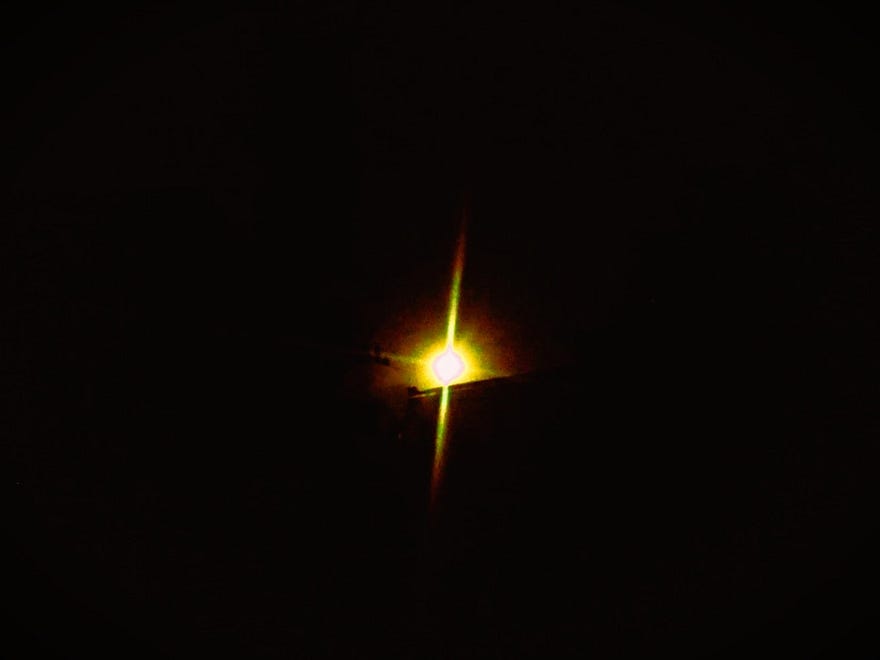
Photo by the author

Disclaimer: As I refer to quantum physics in the following story, I make no claim to have a strong understanding of the concepts. I simply share my perspective based on my somewhat intuitive interpretation of what I have read about it.

A number of years back, I was reading the Diane Duane Young Wizards series. I came to the series on the recommendation of my son, and I truly enjoyed the story. In this series, the wizards’ work is to slow down the entropy that was introduced into the world when one of the Powers of the Universe went rogue, becoming the Lone Power, or the Lone One.

It isn’t hard to draw parallels between this plotline and Judeo-Christian tales of fallen angels and the beginning of death in the world. However, the theology of Duane’s young adult series is not that of traditional religious teachings; rather, it’s more mystical…and more scientific.

Ms. Duane has an educational background in astronomy and astrophysics, and may not have been thinking about theology…but I was. What I was reading about in her books was Process Theology. Duane was writing about life and death. She was writing about teamwork and she was writing about hope.

That’s what it’s all about, you know; hope and our part in maintaining hope in our world.

Death is not the end of things. Isn’t that one of the real messages of religion, that there is nothing to fear from death? Doesn’t religion teach that we are to work together, to give one another hope when the darkness seems inevitable?

The young wizards in the series each have their own Ordeals to undergo, and their own tasks to perform, yet they work with one another to keep the Lone One at bay. In the third book of the series, High Wizardry, Ms. Duane writes of the Lone One, “…It doesn’t have infinite power. It’s peer to all the Powers, but not to That in Which They Move.”

According to Luke, in Acts 17, Paul taught that we “live and move and have our being” in God. Jesus claimed that he was The Light of the World, yet in his Sermon on the Mount, he is recorded as teaching that we are the Light of the World.

How can that be? How can both be true?

Process Theology uses the language of quantum physics to explain the invisible intelligence behind — and in — all creation.

“Wave and particle,” writes theologian Marjorie Suchocki in Divinity and Diversity: A Christian Affirmation of Religious Pluralism, “are both truly light, and we live in a radically incarnational world where truth itself is a many-splendored thing.”

Like the quantum elements of light, God is like a wave that is constantly moving and flowing, until such time as a thinking being perceives the Presence of God. At that point, God is like a particle, and that particle is named according to the cultural expectation of the one who perceives that Presence.

In scientific arenas, that “perceiver” is called the “observer.” For the Christian observer, that “particle” is named Jesus.

I believe that Jesus is a “manifestation of God with us;” as Suchocki writes in God-Christ-Church: A Practical Guide to Process Theology. To continue with the analogy of quantum physics, Jesus is an observable particle of the wave that is God. He is a particle of the Light that when observed reflects the qualities of the ineffable, invisible wave of “All That Is.”

I might call the birth and death of Jesus “event horizons.” In quantum physics, the event horizon is the boundary of a black hole. To enter into a black hole would mean certain death. In his popular book A Brief History of Time: From the Big Bang to Black Holes, physicist Stephen Hawking describes a black hole as a “boundary of the region of space-time from which it is not possible to escape.”

Yet, he describes a singularity as “a point in space-time at which the space-time curvature becomes infinite.” The birth and subsequent resurrection, then, are the “singularities,” for once born, Jesus is an identifiable individual in history; once resurrected, Christ is infinite.

The hope we find in this story is this: as Jesus was the Light of the World, so also are we. We are, each and every one of us, manifestations of “All That Is,” or as Diane Duane writes, “That In Which [We] Move.”

Born of the wave into this material world, we are truly the Light of the World. When we see that, when we connect with the Christ, who is with us in the Holy Spirit, we know the Light as Love, and we begin to reflect it. This is our job. We are the wizards of this world, trusted to slow down the darkness of death and shine the light on eternal love.

We are not perfect reflections of God’s love; indeed, we are flawed and we sometimes fear the things we do not understand. We don’t understand death, this threshold between this world and the next. We don’t understand other people, these also flawed beings whose light may not shine as brightly as another’s or who may seem not to shine any light at all. We need not be perfect.

We need to keep letting our light shine so that it might get into the cracks and ignite their glorious flame. As poet Leonard Cohen wrote, “There is a crack in everything, that’s how the light gets in.”

This Christmas, as we light our candles, say our prayers, and sing our hymns, let us risk allowing our cracks to show, that we might find ourselves poised on the edge of the event horizon, welcoming the Christ into the world.

Let us remember that we are all brilliant particles of the Light of God, and we shine the brightest when we shine together.


(c) Suzy Jacobson Cherry

Is New Age Occult? Mystery, Gnosis, and Spiritual Discernment, Part Eight: What kind of person does a practitioner become?

This is the last part of an 8-part series. You can start with the Introduction here . We began this series with a seemingly simple question:...